
Updated
Basement Ceiling Spray Finish in Youngstown, OH
New Page Reno sprays exposed basement ceilings in one uniform color: joists, subfloor, ducts, pipes, and wires. You keep every inch of headroom and access to everything overhead, for a fraction of the cost of a drop ceiling or drywall. Serving Youngstown, Boardman, Austintown, Canfield, and Poland, with free written estimates usually within 24 hours.
- No headroom lost
- Most basements done in a day
- Fully insured
- Headroom lost
- 0 inches
- Pipes and wires
- Still reachable
- Typical time
- 1 day
What is a basement ceiling spray finish?
A basement ceiling spray finish is a coat of dry-fall paint sprayed over everything on an unfinished basement ceiling (the joists, subfloor, ductwork, pipes, and wiring) in one uniform color. It turns a cluttered ceiling into a clean, open "exposed" look without lowering the ceiling or covering up access to plumbing and electrical.
It's the most affordable way to make an unfinished Mahoning Valley basement feel like part of the house, whether it's becoming a rec room, a home gym, a bar, or just a laundry area you don't mind walking into.
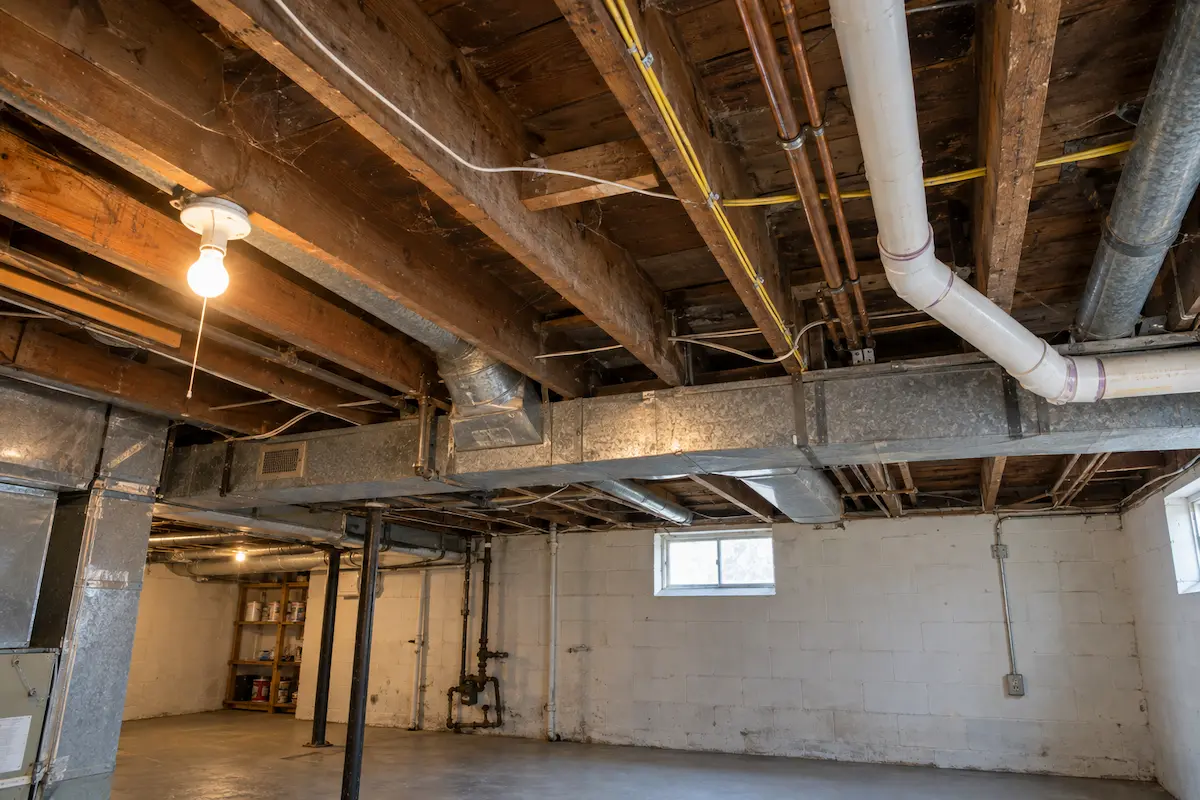
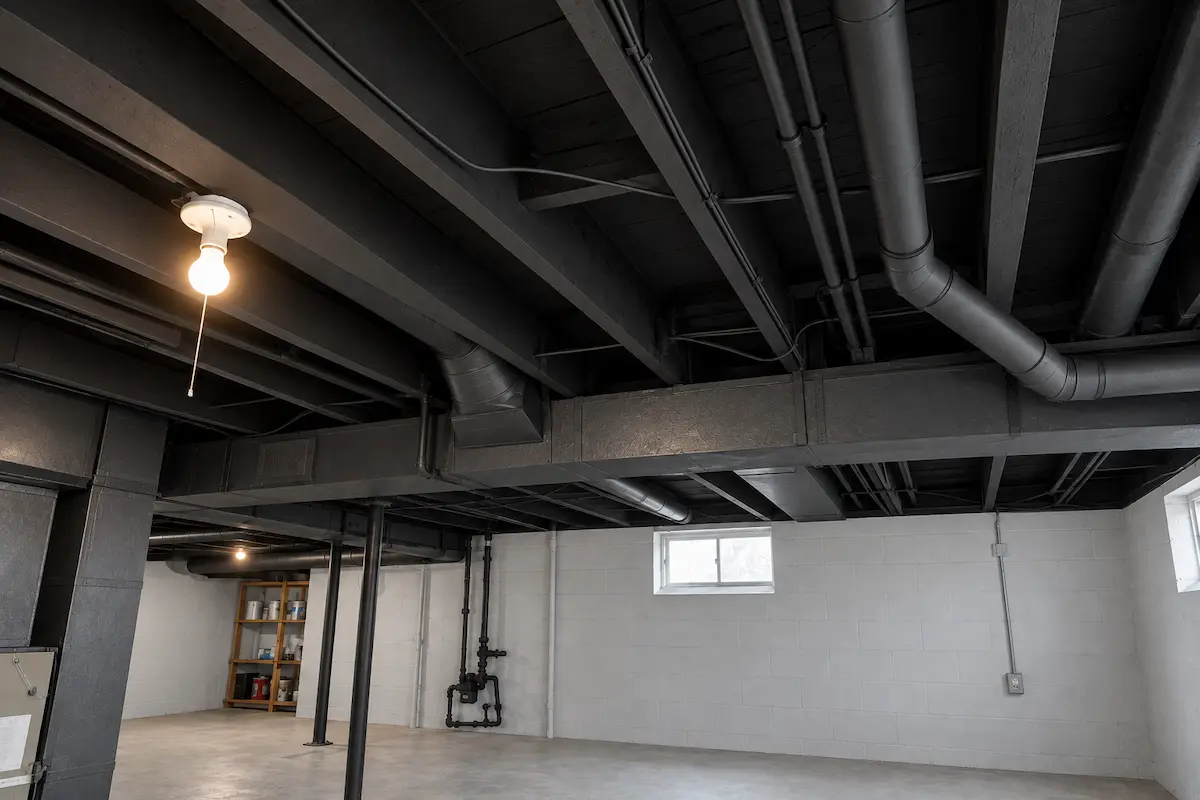
Spray finish vs. drop ceiling vs. drywall
A spray finish costs the least, takes the least time, and is the only option that keeps full headroom and open access to pipes and wires. Drop ceilings and drywall look more "finished" and block more noise, but cost several times more and lower the ceiling.
Enter your basement's size and height to see what each option leaves you with.
Length times width of the basement in square feet
Spray finish
- Finished height
- 7′ 2″
- Headroom lost
- None
- Typical cost
- $1,200–$2,400
- Typical time
- 1 day
- Pipe access
- Fully open
Under 7 feet: check code before finishing this space as a bedroom or living area.
Drop ceiling
- Finished height
- 6′ 10″
- Headroom lost
- 4″ or more
- Typical cost
- $4,800–$9,600
- Typical time
- 2–4 days
- Pipe access
- Lift a tile
Under 7 feet: check code before finishing this space as a bedroom or living area.
Drywall ceiling
- Finished height
- 7′ 1″
- Headroom lost
- About 1″, plus soffits
- Typical cost
- $4,000–$7,200
- Typical time
- 4–7 days
- Pipe access
- Cut a panel
Under 7 feet: check code before finishing this space as a bedroom or living area.
At 800 sq ft with 7′ 2″ to the joists, a spray finish keeps all 7′ 2″ of headroom for about $1,200–$2,400.
Heights are measured to the bottom of the joists in the open part of the room; ducts and beams hang lower with every option. Ranges are for planning only; your free written estimate is the real number.
| Factor | Spray finish | Drop ceiling | Drywall ceiling |
|---|---|---|---|
| Headroom lost | None | At least 3–4″, more under ducts | About 1″, plus soffits around ducts |
| Access to pipes and wires | Everything stays open | Lift out tiles | Cut and patch an access hole |
| Typical cost per sq ft | $1.50–$3.00 | $6–$12 | $5–$9 |
| Typical install time | 1 day for most basements | 2–4 days | 4–7 days with finishing |
| Noise from the floor above | Little change | Reduced with acoustic tiles | Reduced most, especially with insulation |
| Spotting a leak | Visible right away | Stained tile gives it away | Hidden until it shows through |
| Look | Open, industrial loft | Office-style grid | Fully finished room |
What color to paint an exposed basement ceiling
Dark colors like black and charcoal make the ceiling visually disappear and hide pipes and wires best. Light colors like white and light gray bounce more light and make a low basement feel taller.
Black
Best for: media rooms, bars, and taller basements where you want the ceiling to vanish.
Watch out: it absorbs light, so plan on brighter bulbs or a few more fixtures.
Charcoal
Best for: rec rooms and home gyms. Nearly as forgiving as black, a little softer under light.
Watch out: still darkens a basement with only one or two small windows.
Light gray
Best for: basements around 7 feet that need to feel brighter without showing every flaw.
Watch out: dust and cobwebs show sooner than on dark colors.
White
Best for: low ceilings, laundry areas, and workshops where you need light.
Watch out: every wire and pipe stays visible, so tidy cabling matters more.
Rule of thumb: under about 7′ 2″ to the joists, go white or light gray. Taller than that, or turning it into a media room, go charcoal or black.
What we protect, and how to get ready
Spraying is the fast part. Most of spray day goes into cleaning the ceiling and covering everything that shouldn't get paint.
We cover and never paint
- Light fixtures, bulbs, and switches
- Smoke and carbon monoxide detectors
- Furnace, water heater, and their labels and controls
- Gas meter, shutoff valves, and their tags
- Electrical panel
- Fire sprinkler heads, if you have them
- Walls, windows, floors, washer, and dryer
Before we arrive
- Move stored items off high shelves, or to the middle of the floor so they can be covered
- Get any active leaks fixed first
- If an electrician or plumber is coming, schedule them before spray day so new work gets painted too
- Have old pipe insulation tested if the house was built before about 1980
- Point out anything you want left natural, like an old beam or a labeled line
- Plan to keep kids and pets out of the basement until the covers come down
What Mahoning Valley basements need before they're sprayed
Older homes in Youngstown and its suburbs come with basements that have their own quirks. These are the four we check before any paint goes up.
Low ceilings in older homes
Basements in older Youngstown homes often have tight clearance to the joists. A drop ceiling can take 4 inches or more of that; a spray finish takes none, which is often the deciding factor.
Old pipe insulation
White or gray wrap on heating pipes in homes built before about 1980 can contain asbestos. It shouldn't be scraped or disturbed. Have it tested, and we'll plan the job around what the test shows.
Damp, musty basements
A spray finish isn't a moisture fix. Musty joists get cleaned and dried, active leaks get fixed, and a dehumidifier keeps the new finish clean. An open ceiling also makes the next leak easy to spot.
Engineered joists in newer homes
Some newer builds use engineered I-joists, which may need fire-rated protection underneath if the basement is finished as living space. Check with your local building department before choosing an exposed ceiling.
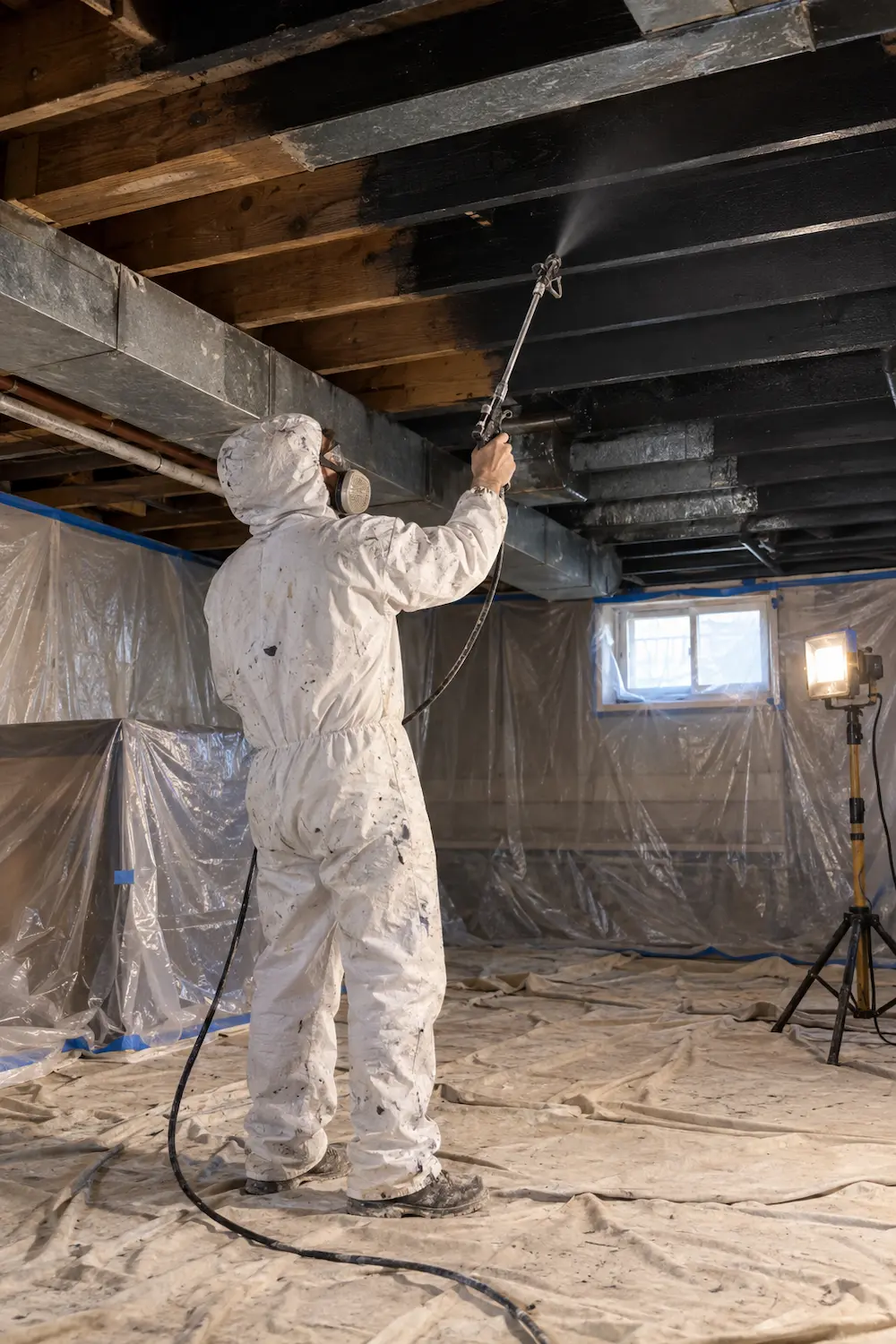
What spray day looks like
Most basements up to about 1,000 square feet are cleaned, masked, sprayed, and cleaned up in one day. Larger or very cluttered ceilings take two.
Walkthrough
We confirm the color, what stays unpainted, and where the water and gas shutoffs are.
Clean the ceiling
Dust and cobwebs are vacuumed and blown down so the coating bonds to wood and metal, not dirt.
Mask and cover
Walls, windows, floors, lights, detectors, and mechanicals are wrapped and taped off.
Spray
An airless sprayer hits each joist bay from both directions, so the sides of joists and the backs of pipes get covered too.
Inspect and touch up
Work lights go across the whole ceiling to catch thin spots and missed corners.
Unmask and walk through
Covers come down, the floor is swept, and we walk the finished basement with you.
What a basement ceiling spray finish costs in Youngstown
Most basement ceiling spray finishes in the Youngstown area cost about $1.50–$3.00 per square foot, or roughly $1,200–$2,400 for a typical 800-square-foot basement. That's often a third or less of the cost of a drop ceiling or drywall.
What moves the price
- Ceiling square footage
- How much needs masking
- Cleaning and cobweb removal
- Color change (white over dark wood may need more coats)
- Stairwells, soffits, and beams
- Adding walls or floors to the job
Paint the walls the same week
Block walls and stairwells look best finished alongside the ceiling, and it's cheaper to do them in one trip while everything is already covered. See interior painting.
Wiring and plumbing first
Schedule any electrical or plumbing changes before spray day so new wires and pipes get painted with everything else, instead of standing out afterward.
Basement ceiling spraying across the Mahoning Valley
Based in Canfield, we spray basement ceilings for homeowners, landlords, and flippers in three counties. Don't see your town? Call (330) 727-8761.
Mahoning County
- Youngstown
- Boardman
- Austintown
- Canfield
- Poland
- Struthers
- Campbell
- North Lima
Trumbull County
- Warren
- Niles
- Howland
- Hubbard
- Liberty
- Girard
- Cortland
Columbiana County
- Salem
- Columbiana
- Leetonia
- Lisbon
Basement ceiling spray finish questions
Straight answers to what Valley homeowners ask before painting an exposed basement ceiling.
How much does it cost to spray a basement ceiling in Youngstown, OH?
How long does it take to spray a basement ceiling?
What color should I paint my basement ceiling?
Is spraying a basement ceiling cheaper than a drop ceiling or drywall?
Do you lose ceiling height with a spray finish?
Can I still get to my pipes and wires after the ceiling is sprayed?
What kind of paint is used on a basement ceiling?
Does a painted basement ceiling reduce noise?
Can old pipe insulation be painted over?
Can we stay home while the basement ceiling is sprayed?
Get a free basement ceiling estimate
Tell us the size of your basement and the color you're leaning toward. We'll set up a walkthrough and send an itemized, no-pressure quote, usually within 24 hours.
Two numbers for a faster quote
- Length times width of the basement, in feet
- Height from the floor to the bottom of the joists
- A couple of phone photos of the ceiling help too